

Primary Care Physician in Los Angeles: Is Yours Actually Managing Your Whole Health?
At Scintadel Healthcare, Inc., we approach primary care as the clinical foundation that makes everything else work. A primary care physician in Los Angeles isn’t the provider you see when something is wrong. They’re the provider who prevents the wrong thing from happening in the first place, who catches the early signs that specialist care will miss because specialists only see their slice of the picture, and who holds the whole clinical narrative when your health involves more than one condition or more than one provider.
Why Does Fragmented Healthcare Specifically Hurt Primary Care Patients?
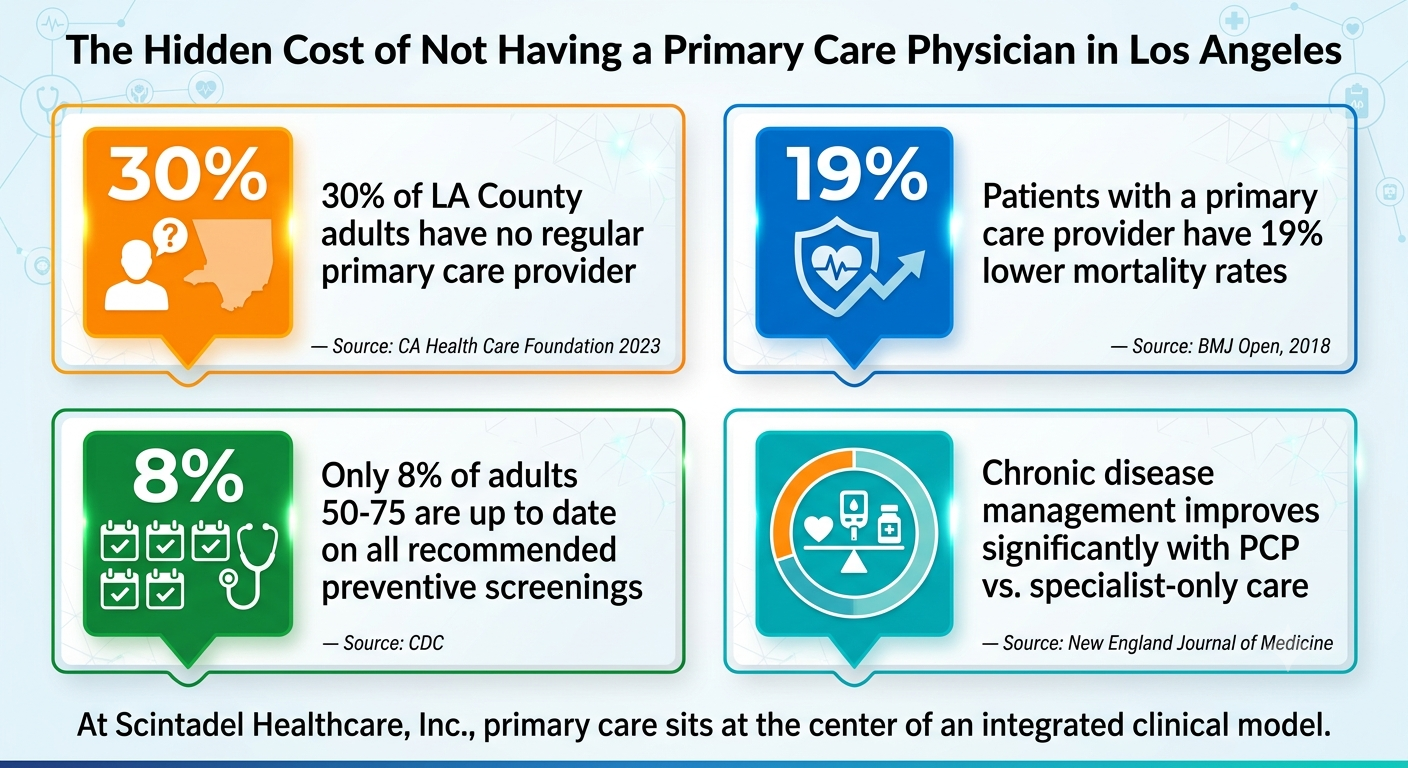
Healthcare fragmentation is a national problem, but it’s particularly pronounced in large metropolitan areas where patients have access to many specialists but may lack a consistent primary care relationship that coordinates across them. The California Health Care Foundation has documented that nearly 30% of Los Angeles County residents report not having a regular primary care provider. The clinical consequences of that gap are measurable: higher rates of emergency department use for conditions that could have been managed preventively, lower rates of recommended cancer screenings, and delayed diagnosis of chronic conditions including hypertension, type 2 diabetes, and thyroid disorders.
The fragmentation problem compounds when patients are seeing multiple specialists without a primary care physician holding the clinical overview. A cardiologist managing blood pressure, an endocrinologist managing thyroid dysfunction, and a psychiatrist managing depression may all be prescribing medications without a single clinician checking for interactions, redundancies, or the way each specialist’s recommendations affects what the others are doing. A primary care physician in that picture isn’t administrative overhead. They’re the clinician preventing medical errors and optimizing treatment across the full picture.
At Scintadel Healthcare, Inc., we approach primary care as the clinical foundation that makes everything else work. A primary care physician in Los Angeles isn’t the provider you see when something is wrong. They’re the provider who prevents the wrong thing from happening in the first place, who catches the early signs that specialist care will miss because specialists only see their slice of the picture, and who holds the whole clinical narrative when your health involves more than one condition or more than one provider.
What Does Preventive Care at a Quality Primary Care Practice Actually Involve?
Preventive care is where primary care produces its highest clinical value, and it’s also where the most variation exists between practices that are genuinely thorough and those that run annual physicals as a checkbox exercise.
At a quality practice, a preventive visit applies the U.S. Preventive Services Task Force (USPSTF) evidence-based screening guidelines as the framework rather than a fixed menu of tests ordered the same way for every patient. The relevant screenings vary by age, sex, family history, lifestyle, and risk factors. Here’s what a thorough preventive care visit actually covers:
| Screening Category | What It Catches | Who Needs It |
| Blood pressure | Hypertension (often asymptomatic) | Adults 18+ annually |
| Fasting glucose and HbA1c | Prediabetes and type 2 diabetes | Adults 35-70 with overweight/obesity; sooner with risk factors |
| Lipid panel | Cardiovascular risk; dyslipidemia | Adults 20+ per USPSTF guidelines |
| Thyroid function (TSH) | Hypothyroidism, hyperthyroidism | Symptomatic patients; women over 50 |
| Colorectal cancer screening | Colorectal cancer | Adults 45+ per USPSTF 2021 update |
| Mammography | Breast cancer | Women 40-74 per shared decision-making |
| PHQ-9 (depression screen) | Major depressive disorder | Adults at preventive visits |
| GAD-7 (anxiety screen) | Generalized anxiety disorder | Adults at preventive visits |
| BMI and weight trajectory | Obesity, metabolic risk | Adults annually |
| Immunization status | Influenza, COVID, shingles, RSV, tetanus | Per age-based schedule |
At Scintadel Healthcare, Inc., a positive screen connects directly to the psychiatric team within the same practice. This of course, helps to convert findings into an actionable clinical pathway rather than a referral that may or may not be followed.
How Does Primary Care Integration With Psychiatry Change Mental Health Outcomes?
The integration between primary care and psychiatry at Scintadel Healthcare, Inc. produces specific clinical benefits that neither service delivers alone. A primary care physician who identifies depression or anxiety at a preventive visit and can immediately connect the patient to a psychiatrist within the same clinical team converts a detection moment into a treatment pathway rather than a referral that patients often don’t pursue.
Conversely, a psychiatrist prescribing a mood stabilizer who has direct communication with the patient’s primary care physician can ensure that metabolic side effects, common with several mood stabilizers and atypical antipsychotics, are monitored by a clinician who is already tracking the patient’s baseline metabolic markers. That kind of coordinated monitoring prevents the chronic secondary health problems that psychiatric medication side effects can produce when no one is systematically watching for them.
What Should Patients Expect From a Primary Care Physician?
A primary care physician in Los Angeles, CA at a quality integrated practice offers more than symptom management and prescription refills. Here’s what patients should reasonably expect and advocate for:
A consistent provider across visits rather than a different physician each time. Continuity of care is one of the strongest predictors of positive health outcomes in the primary care research literature. A 2018 study in BMJ Open found that patients with continuity of care had significantly lower mortality rates than those who saw different providers at each visit, independent of socioeconomic factors.
An annual preventive visit that applies the USPSTF guidelines systematically rather than ordering the same standard panel for every patient regardless of individual risk factors. A referral coordination model that transmits clinical context to specialists rather than sending patients with a phone number and the instruction to make an appointment. Mental health screening integrated into standard preventive care rather than treated as a separate department.
The Scintadel Healthcare home page outlines the full integrated care model and how primary care connects to psychiatric and holistic services. The previously published Scintadel blog on primary care in Los Angeles from Month 2 provides additional clinical context. Reach out through the contact page to establish primary care at Scintadel Healthcare, Inc.
Why Scintadel Healthcare, Inc.
A primary care physician who knows your history, applies preventive care systematically, coordinates across your specialists, and connects directly to psychiatric and holistic services when the clinical picture calls for it is providing something qualitatively different from a clinic that processes annual physicals efficiently. Scintadel Healthcare, Inc. builds its primary care model around the former standard, and that difference shows in what patients can expect from their health over the long term.
FAQs
- Does Scintadel Healthcare, Inc. accept Medicare for primary care services in Los Angeles?
Scintadel accepts Medicare as well as major commercial insurers including Cigna, United Healthcare, and BlueCross BlueShield, making primary care services accessible to patients across the Los Angeles region. - How often should I see my primary care physician if I don’t have a diagnosed chronic condition?
Annual preventive visits are recommended for all adults regardless of chronic disease status. These visits allow systematic preventive screening and early detection of conditions that frequently develop without symptoms. - Can my primary care physician at Scintadel coordinate with my other specialists?
Yes. Scintadel’s integrated care model is specifically built for coordination across primary care, psychiatry, and specialist providers, ensuring that clinical context is shared rather than siloed. - What happens if my primary care physician identifies a mental health concern during a routine visit?
A mental health concern identified during a primary care visit at Scintadel connects directly to the psychiatric team through a coordinated internal referral, converting a screening finding into an actionable treatment pathway without requiring the patient to navigate a separate external referral. - Does Scintadel Healthcare offer telehealth for primary care appointments?
Yes. Telehealth primary care appointments are available for patients whose concerns can be addressed remotely, providing flexibility for patients managing demanding Los Angeles schedules.