

Addiction Treatment in Los Angeles: Why Recovery is More Than Just Stopping?
Key Takeaways
- Addiction is classified as a chronic brain disorder by the American Society of Addiction Medicine. It is not a willpower failure.
- Sustained substance use structurally alters the brain’s dopamine reward pathways, prefrontal cortex function, and stress response system.
- Medication-assisted treatment for opioid and alcohol use disorders significantly reduces relapse rates, overdose risk, and mortality.
- More than 60% of people in addiction treatment have a co-occurring mental health disorder. Treating both simultaneously produces far better outcomes.
- Recovery is not a single event. It is a clinical process requiring neurobiological, psychological, and social support over time.
- Telehealth has expanded access to addiction treatment for patients across Los Angeles and Orange County.
At Scintadel Healthcare, Inc., the most consistent thing we observe working with patients in recovery across Southern California is that stopping substance use is only the beginning. Addiction treatment in Los Angeles at a clinical level is not about willpower management or accountability programs. It is about addressing the neurological, psychological, and social dimensions of a condition that changes how the brain functions in measurable and lasting ways.
That framing shapes everything about how treatment should be structured. An approach built primarily around abstinence motivation produces different results than one built around neurobiological rehabilitation, behavioral skill-building, and the management of co-occurring mental health conditions that often drive substance use in the first place.
What Does Addiction Actually Do to the Brain, and Why Does That Change Treatment?
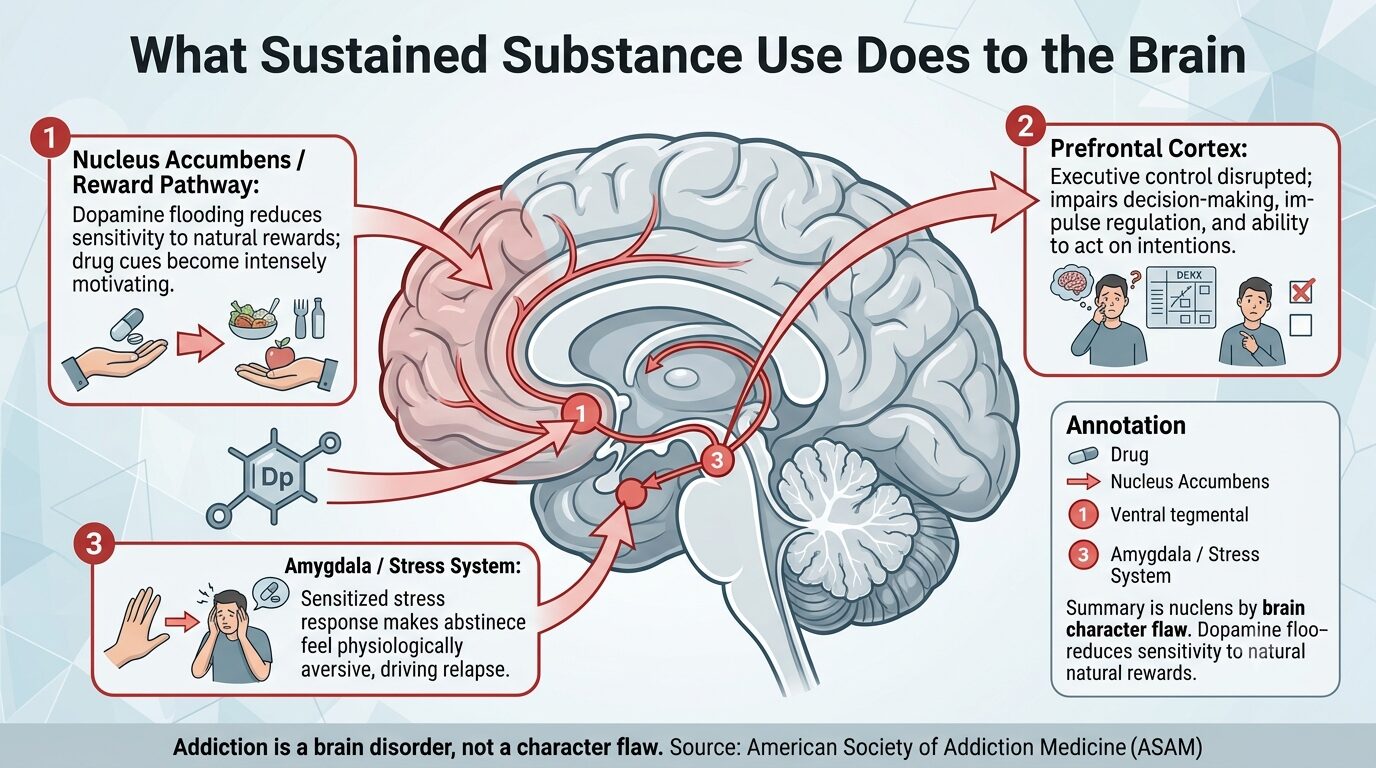
Addiction is classified as a chronic brain disorder by the American Society of Addiction Medicine, and that classification carries direct clinical implications. Sustained substance use alters the brain’s dopamine reward pathways in ways that make natural rewards less satisfying and drug-associated cues intensely motivating. It disrupts the prefrontal cortex’s capacity for executive control, which is why people with addiction struggle to act consistently on intentions they genuinely hold. It sensitizes the stress response system, making abstinence periods feel physiologically aversive in ways that drive relapse even when the motivation to stay clean is sincere.
According to the National Survey on Drug Use and Health, approximately 46.3 million Americans aged 12 or older met the criteria for a substance use disorder in 2021. In Los Angeles County, substance use disorders are among the most common mental health-related presentations in both emergency department and outpatient clinical settings. Understanding the neuroscience behind that number changes how treatment must be built.
How Addiction Changes the Brain
What Does Evidence-Based Addiction Treatment Look Like in Practice?
Evidence-based addiction treatment combines several components that are individually supported and even more effective in combination. The table below outlines the core evidence-based interventions available through a clinical treatment model:
| Treatment Component | What It Addresses | Evidence Level |
|---|---|---|
| Medication-Assisted Treatment (MAT) | Neurobiological drive to use; withdrawal management | FDA-approved; strong RCT evidence |
| Cognitive Behavioral Therapy (CBT) | Thought patterns and behaviors maintaining substance use | Extensively researched across substance types |
| Motivational Enhancement Therapy | Ambivalence about recovery; building intrinsic motivation | Strong evidence for early-stage intervention |
| Group Therapy / Peer Support | Social connection; shared accountability | Widely supported as adjunctive component |
| Co-occurring disorder treatment | Depression, anxiety, PTSD, ADHD driving substance use | Essential; improves recovery outcomes significantly |
| Relapse Prevention Planning | Trigger identification; coping strategy development | Standard of care across addiction treatment guidelines |
For opioid use disorder specifically, buprenorphine and naltrexone are FDA-approved and have been shown to significantly reduce relapse rates, overdose risk, and mortality. For alcohol use disorder, naltrexone, acamprosate, and disulfiram each address different physiological aspects of the drive to drink. These medications are not substitutes for recovery. They are tools that reduce the neurobiological signal that makes resisting substances so physiologically difficult.
The Scintadel Healthcare homepage reflects the full care ecosystem within which addiction treatment operates, connecting medical, psychiatric, and holistic services for patients who need more than a single clinical modality.
How Does Addiction Treatment in Orange County Fit Into the Scintadel Model?
Addiction treatment in Orange County through Scintadel Healthcare, Inc. operates within the same integrated framework as our Los Angeles services. Orange County has faced significant opioid-related challenges affecting communities across the county regardless of socioeconomic background. Families and individuals in Orange County seeking evidence-based treatment close to home have access to the same quality of clinical care through Scintadel’s service model.
| Service Dimension | Los Angeles | Orange County |
|---|---|---|
| Psychiatric evaluation | In-person and telehealth | Telehealth and select in-person |
| Medication-assisted treatment | Available | Available |
| Co-occurring disorder treatment | Available | Available |
| Coordination with primary care | Built-in integrated model | Built-in integrated model |
| Insurance accepted | Major commercial insurers | Major commercial insurers |
The Orange County service area page outlines how Scintadel serves patients across the county. Telehealth has further extended that reach, making psychiatric evaluation and medication management for substance use disorders accessible for Orange County residents without requiring travel to Los Angeles clinical locations.
Why Does Treating Co-Occurring Mental Health Conditions Matter for Recovery?
The National Institute on Drug Abuse reports that more than 60% of people in addiction treatment have a diagnosable mental health disorder. Depression, anxiety, PTSD, and ADHD are the most common co-occurring diagnoses. These conditions are often primary drivers of substance use: people use substances to manage symptoms of conditions they don’t have language for or treatment access to address directly. The outdated clinical model of achieving sobriety before treating mental health conditions ignores the reality that untreated mental health symptoms are one of the strongest predictors of relapse.
At Scintadel Healthcare, Inc., co-occurring disorders are treated simultaneously. Our general psychiatry services are available to addiction patients as an integral component of their recovery plan. For more on how mental health and addiction intersect, the Scintadel blog on mental health facilities in Los Angeles addresses the integrated care model in detail.
Contact the team through the contact page to discuss how Scintadel Healthcare’s addiction treatment services can be structured around your specific situation. For a thorough clinical overview of substance use disorders, the Wikipedia entry on substance use disorder is a useful reference.
Why Scintadel Healthcare, Inc. Offers Los Angeles and Orange County a Recovery Model That Actually Holds
Recovery is not a single event. It is a clinical process requiring the right combination of neurobiological, psychological, and social support. Scintadel Healthcare, Inc. brings all three together for patients across Los Angeles and Orange County, making recovery something built to last.
Frequently Asked Questions
- Does Scintadel Healthcare, Inc. offer medication-assisted treatment for opioid use disorder?
Yes. Buprenorphine and naltrexone are available when clinically indicated and are integrated into a comprehensive recovery plan that includes behavioral and psychiatric support.
- Can patients with active substance use access addiction treatment at Scintadel Healthcare?
Yes. Patients do not need to be in abstinence to begin evaluation and treatment. The clinical team assesses each patient’s situation and develops an appropriate plan.
- Are co-occurring mental health conditions treated alongside addiction at Scintadel?
Yes. Scintadel treats co-occurring conditions as part of the addiction recovery plan, recognizing that simultaneous treatment produces significantly better outcomes than sequential approaches.
- Is addiction treatment covered by insurance at Scintadel Healthcare?
Major commercial insurers cover substance use disorder treatment under mental health parity laws. The Scintadel team can verify your specific coverage before your initial appointment. - How long does addiction treatment typically last at Scintadel Healthcare?
Treatment duration depends on the severity of the disorder, co-occurring conditions, and individual response. Scintadel supports patients through every phase of recovery rather than discharging at a fixed endpoint.