

Counseling in Pasadena, CA: Is What You Call It Getting in the Way of Help?
Key Takeaways
- Counseling, therapy, and psychiatry serve different but overlapping purposes. Understanding the distinction helps patients start in the right place.
- Counseling is most effective for identifiable stressors, life transitions, and adjustment challenges, not necessarily for severe or long-standing psychiatric conditions.
- The most effective mental health care typically combines counseling or therapy with psychiatric evaluation and, when appropriate, medication management.
- Rancho Cucamonga and the broader Inland Empire are designated mental health professional shortage areas by federal standards.
- Telehealth counseling has made consistent care significantly more accessible for patients in Pasadena, Rancho Cucamonga, and across Southern California.
- Insurance coverage for counseling and psychotherapy is required under federal mental health parity laws.
At Scintadel Healthcare, Inc., we regularly hear from patients who put off seeking mental health support because they weren’t sure whether they needed counseling, therapy, or psychiatry, and didn’t want to start in the wrong place. That confusion is understandable, but it has a real cost in delayed care and prolonged suffering. Whether you are in Pasadena or Rancho Cucamonga, understanding what counseling in Pasadena, CA means in a clinical context is the most useful first step you can take.
What Is the Clinical Difference Between Counseling, Therapy, and Psychiatry?
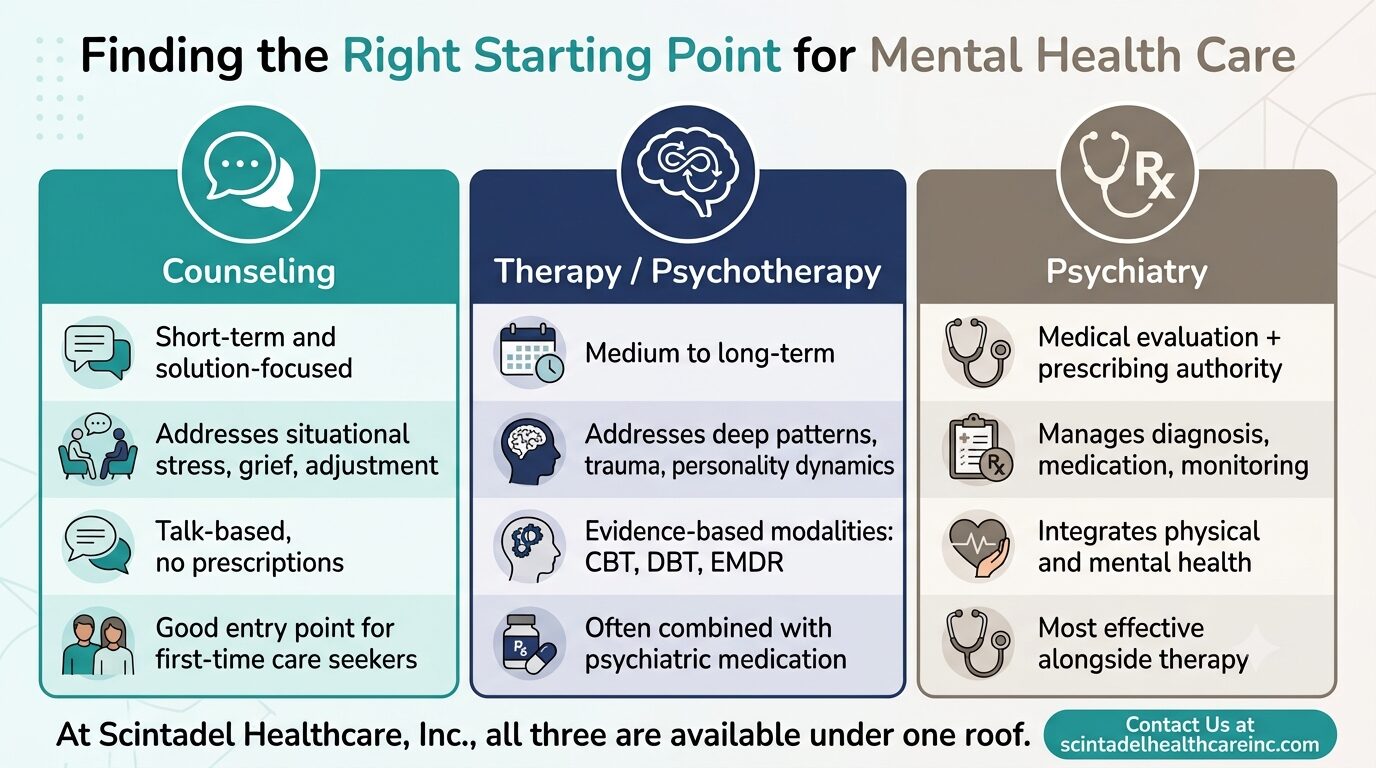
The terms counseling and therapy are often used interchangeably, and in many clinical contexts they refer to overlapping practices. Technically, counseling tends to refer to shorter-term, solution-focused interventions addressing specific life challenges, adjustment issues, relationship difficulties, or situational distress. Psychotherapy is typically more in-depth and may address longer-standing patterns, childhood experiences, or complex psychiatric conditions over a longer period.
Psychiatry is distinct in that a psychiatrist is a medical doctor who can prescribe medications and integrates biological, psychological, and social perspectives on mental health. A counselor or therapist typically holds a master’s or doctoral degree in psychology, counseling, or social work and provides talk-based interventions without prescribing authority.
The table below makes these distinctions concrete:
| Modality | Provider Type | Can Prescribe? | Best For | Typical Duration |
|---|---|---|---|---|
| Counseling | LPCC, LMFT, LCSW | No | Situational stress, life transitions, adjustment | Short-term (6–12 sessions) |
| Psychotherapy | Psychologist, LCSW, LMFT | No | Complex patterns, trauma, long-standing conditions | Medium to long-term |
| Psychiatry | MD or DO (Psychiatrist) | Yes | Diagnosis, medication management, complex cases | Ongoing as needed |
| Integrated Care | Multidisciplinary team | Psychiatrist on team | Complex presentations needing all three | Individualized |
In practice, the most effective mental health care often combines all three. Medication stabilizes brain chemistry. Therapy addresses cognitive and emotional patterns. Counseling navigates the specific circumstances currently causing distress. These aren’t competing approaches. They address different dimensions of the same person.
Counseling vs. Therapy vs. Psychiatry: Which One Do You Need?
Who Benefits Most From Counseling as a Primary Mental Health Intervention?
Counseling is most effective for people dealing with identifiable stressors or life transitions that are causing functional impairment but don’t involve severe psychiatric conditions requiring intensive pharmacological management. This includes grief and loss, relationship difficulties, career transitions and work-related stress, adjustment to chronic illness or medical diagnosis, parenting challenges, and situational anxiety tied to specific circumstances.
It is also an excellent entry point for people who are uncertain whether they need mental health support and want to explore what they’re experiencing before committing to longer-term therapy or psychiatric evaluation. Here is a framework for thinking about when counseling is the right starting point:
| Situation | Counseling Likely Right | Consider Adding Therapy or Psychiatry |
|---|---|---|
| Recent bereavement or loss | Yes | If grief is complicated or prolonged |
| Work-related burnout | Yes | If depression or anxiety symptoms are severe |
| Relationship difficulties | Yes | If attachment patterns are long-standing |
| Major life transition | Yes | If adjustment is significantly impairing function |
| Anxiety about specific situation | Yes | If anxiety is generalized or panic-level |
| Long-standing depression | No | Yes, psychiatric evaluation recommended |
| Trauma history | No | Yes, trauma-specific therapy needed |
| Medication management needed | No | Yes, psychiatry required |
Our general psychiatry services at Scintadel Healthcare, Inc. incorporate counseling as part of a broader continuum of care, ensuring patients have access to the right level of support at each stage.
How Does Counseling in Rancho Cucamonga Work Through Scintadel’s Model?
Counseling Rancho Cucamonga, CA through Scintadel Healthcare, Inc. reflects the same integrated philosophy applied in Pasadena and across Southern California. Rancho Cucamonga is part of the Inland Empire, a region where mental health access has historically been constrained by provider shortages. The Health Resources and Services Administration designates San Bernardino County as a mental health professional shortage area, meaning the ratio of mental health providers to residents falls below federally established adequacy thresholds.
Bringing high-quality counseling services to Rancho Cucamonga residents, alongside the full spectrum of psychiatric and holistic care, is part of Scintadel’s commitment to closing that access gap. Telehealth has been transformative in this context: patients in Rancho Cucamonga can access initial consultations, ongoing sessions, and psychiatric coordination virtually, removing the geographic and logistical barriers that previously made consistent mental health care difficult for Inland Empire residents.
The Scintadel Healthcare homepage provides a full picture of how counseling fits within the broader care model. For patients interested in how mental health care connects with integrated services, the Scintadel blog on addiction treatment in Los Angeles and Orange County illustrates how different clinical modalities work in concert. Contact the team through the contact page to discuss where counseling fits in your specific situation.
What Does the First Counseling Session at Scintadel Healthcare Actually Involve?
The first session is primarily an assessment, not a deep dive into the most difficult material. The counselor will ask about what brought you in, the specific issues you’re hoping to address, your history with mental health support, and relevant life history that provides context for what you’re currently experiencing. You will also have the opportunity to ask questions about the counselor’s approach, what sessions typically look like, and what to expect over time.
You are not expected to share everything in the first session. Trauma-informed and person-centered counseling is built around pacing and trust. It should feel like a conversation, not an interrogation, and you should leave with a clearer sense of what the counselor is proposing and why. For general background on counseling approaches and their effectiveness, the Wikipedia entry on psychotherapy provides useful foundational context.
How Scintadel Healthcare, Inc. Makes Counseling in Pasadena and Rancho Cucamonga Actually Work for You
The right kind of support at the right time changes what mental health care can accomplish. Scintadel Healthcare, Inc. brings counseling into a clinical ecosystem that makes it more effective, more coordinated, and more sustainable than standalone counseling in either Pasadena or Rancho Cucamonga.
Frequently Asked Questions
- Is counseling at Scintadel Healthcare available through telehealth for Rancho Cucamonga residents?
Yes. Telehealth counseling sessions are available for patients across Southern California, including Rancho Cucamonga, with the same quality of care as in-person sessions.
- How many counseling sessions are typically needed before seeing improvement?
Research on short-term counseling suggests meaningful improvement for many patients within 6 to 12 sessions, though complex presentations may require longer engagement.
- Can counseling be combined with psychiatric medication management at Scintadel Healthcare?
Yes. Combining counseling with medication management is often more effective than either approach alone, or Scintadel’s integrated model makes that coordination straightforward.
- Does Scintadel Healthcare offer counseling specifically for grief or loss?
Yes. Grief counseling is part of the range of services available through Scintadel, addressing bereavement, anticipatory grief, and complicated grief presentations.
- Is counseling at Scintadel covered by insurance?
Yes. Counseling and psychotherapy services are covered by major commercial insurers under mental health parity laws. The Scintadel team can verify your specific plan’s coverage before your first session.