

Mental Health Facilities in Los Angeles: What are You Missing Out?
Key Takeaways
- Not all mental health facilities in Los Angeles offer the same scope of care. Integrated models that combine psychiatry, primary care, and holistic services produce significantly better outcomes.
- A quality facility should provide thorough psychiatric evaluations of at least 60 minutes, not rushed intake appointments.
- Continuity of care, seeing the same clinical team across visits, is one of the strongest predictors of positive mental health outcomes.
- Co-occurring physical health conditions are extremely common alongside psychiatric diagnoses and must be addressed together, not separately.
- Telehealth has expanded access to quality mental health care for residents across all of Los Angeles County.
- Insurance coverage for mental health services is required under federal parity laws, making care more accessible than many patients assume.
Los Angeles has no shortage of mental health providers. Walk through any neighborhood in the city and you will find therapists, wellness centers, and telehealth apps advertising their services on every corner. But having access to a provider is not the same as having access to quality care, and the gap between those two things is where a lot of people quietly fall through.
At Scintadel Healthcare, Inc., we have thought carefully about what a mental health facility in Los Angeles should actually deliver. Not in theory, not in a brochure, but in the clinical reality of what patients experience on their second visit and their sixth and their twelfth. The answer shapes everything about how we have built our practice.
What Makes a Mental Health Facility in Los Angeles Genuinely Comprehensive?
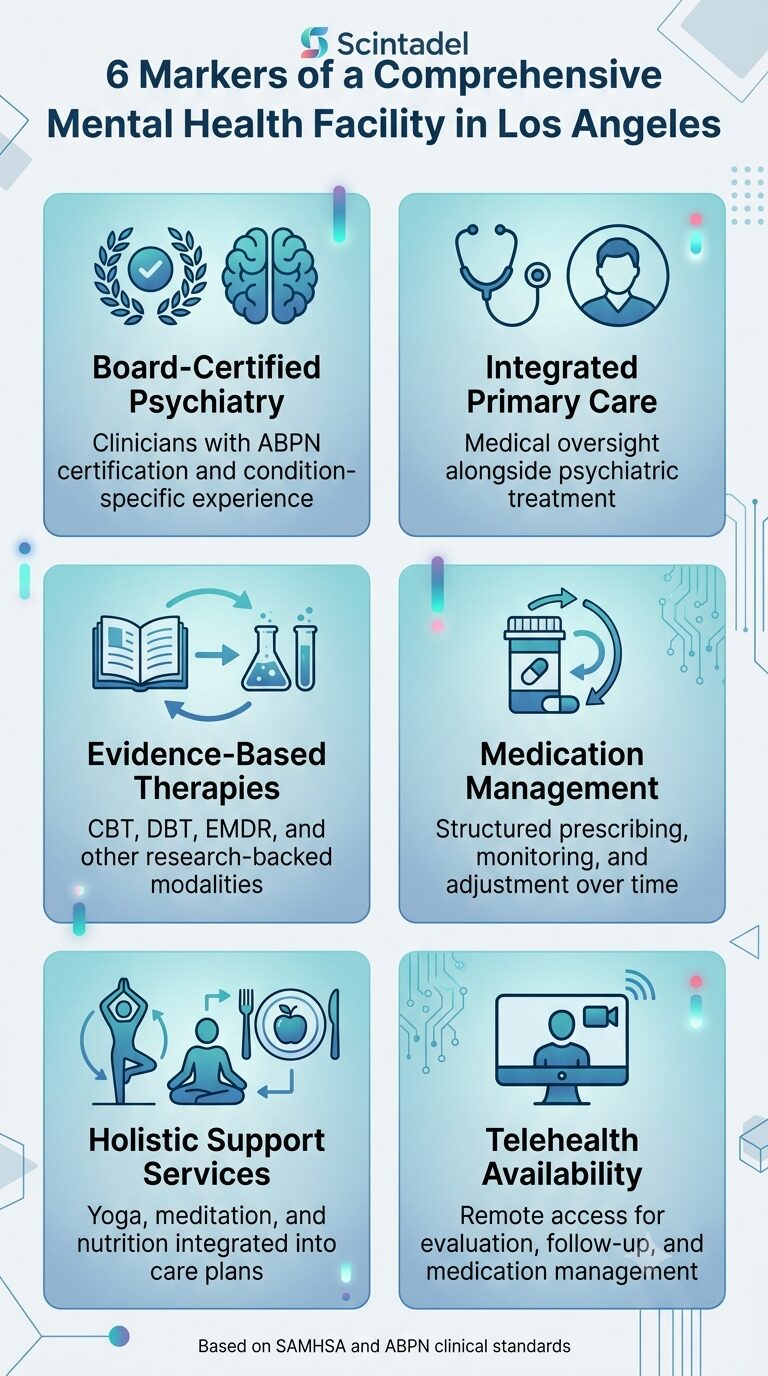
Comprehensive care in mental health has a specific clinical meaning. A comprehensive mental health facility in Los Angeles must be able to evaluate and treat the full range of common psychiatric conditions, including mood disorders, anxiety disorders, trauma-related conditions, ADHD, OCD, psychosis, and substance use disorders. It should provide both psychiatric evaluation and medication management alongside psychotherapy services. And it must address the physical health dimensions of mental illness, not treat the mind as if it exists separately from the body.
According to the Substance Abuse and Mental Health Services Administration, only about 46% of adults with mental illness in the United States received any treatment in 2021. In Los Angeles County, where cost, wait times, cultural factors, and provider shortages compound one another, that figure is likely lower. A facility that operates with genuine accessibility, including insurance coverage for major commercial plans, telehealth options, and multilingual services, addresses a structural problem as much as a clinical one.
6 Markers of a Comprehensive Mental Health Facility in Los Angeles
How Does Integrated Care Change What a Mental Health Facility Can Offer?
When psychiatry, primary care, and holistic services operate within the same clinical environment and share patient information across care teams, several things become possible that aren’t possible in siloed systems. Medication decisions in psychiatry can be made with awareness of the patient’s recent laboratory results and physical health status. Primary care visits can flag mental health concerns and route patients to psychiatric evaluation without the loss of context that typically occurs when a referral crosses two separate practices that don’t communicate.
At Scintadel Healthcare, Inc., this integration is the structural reality of how we operate, not a marketing description. Here is what that looks like in practice for a patient in our system:
| Care Component | What It Does for the Patient |
|---|---|
| Psychiatric evaluation | Incorporates physical health history from the primary care team |
| Medication management | Informed by real-time laboratory monitoring |
| Therapy coordination | Warm referral to appropriate modality without loss of clinical context |
| Yoga and holistic services | Coordinated with clinical treatment goals, not offered as disconnected add-ons |
| Primary care oversight | Monitors for psychiatric medication side effects including metabolic changes |
| Cross-team communication | Consistent shared records rather than siloed treatment notes |
Our general psychiatry services exist within this integrated framework. Every patient who comes to Scintadel for mental health care has access to the full clinical ecosystem of our practice.
What Should Patients Look for When Evaluating a Mental Health Facility?
The most important questions when evaluating a mental health facility in Los Angeles concern credentialing, scope, and continuity. Are the clinicians board-certified in psychiatry or appropriately licensed in their respective disciplines? Does the facility accept your insurance? Does it have specific experience with your condition?
The table below compares what a comprehensive integrated facility offers versus what a standard standalone mental health practice typically provides:
| Feature | Integrated Facility (e.g., Scintadel) | Standalone Mental Health Practice |
|---|---|---|
| Psychiatric evaluation depth | 60–90 min with medical history review | Often 20–30 min intake |
| Primary care coordination | Built-in, same clinical team | External referral, often no communication |
| Medication + therapy together | Available under one roof | Requires two separate providers |
| Holistic services | Yoga, meditation, nutrition integrated | Typically not offered |
| Telehealth | Available for all service lines | Varies widely |
| Insurance coverage | Major commercial insurers accepted | Varies by practice |
| Continuity of care | Same clinical team across visits | Provider rotation common |
Continuity of care is one of the strongest predictors of positive mental health outcomes in the research literature. Seeing the same clinician across appointments allows for the kind of accumulated clinical knowledge that enables better treatment decisions over time. Facilities that rotate patients across different providers at each visit lose that continuity and the clinical benefit that comes with it.
How Does Scintadel Healthcare, Inc. Approach Mental Health Care Differently?
We approach mental health care at Scintadel with the conviction that no single intervention resolves complex psychiatric conditions on its own. Medication helps regulate brain chemistry. Therapy addresses cognitive and behavioral patterns. Holistic services support the nervous system and build resilience. Primary care monitors the physical health dimensions of psychiatric illness. None of these components works as well in isolation as it does within a coordinated system.
That philosophy translates into a patient experience that is more attentive, more adjustable, and more likely to produce lasting results than episodic, single-modality treatment. Patients who come to us with complex presentations, multiple diagnoses, or prior treatment failures have access to the full range of clinical tools rather than a limited menu of options.
For patients who want more context on how integrated care connects mental health with other dimensions of wellbeing, our published blog on yoga retreats and meditation in Riverside offers a useful lens on the holistic philosophy behind our practice. Reach out through the contact page to schedule an initial evaluation. For a foundational clinical overview of mental health systems, the Wikipedia entry on mental health provides useful context.
Why Scintadel Healthcare, Inc. Sets a New Standard for Mental Health Facilities in Los Angeles
Quality mental health care in Los Angeles is available. What it takes to access it consistently is the right practice, one built around integration, continuity, and clinical comprehensiveness. Those are the things that actually move people forward, and they are what Scintadel Healthcare, Inc. is built around.
Frequently Asked Questions
- What types of mental health conditions does Scintadel Healthcare, Inc. treat?
Scintadel treats depression, anxiety, ADHD, OCD, PTSD, bipolar disorder, and substance use disorders within an integrated medical and holistic care model.
- Does Scintadel Healthcare, Inc. accept insurance for mental health services?
Yes. Scintadel accepts major commercial insurers including Cigna, United Healthcare, and BlueCross BlueShield. Contact the team to verify your specific coverage before your first appointment.
- Is telehealth available for mental health appointments at Scintadel Healthcare?
Yes. Telehealth is available for psychiatric evaluations, medication management, and follow-up appointments across the greater Los Angeles area.
- How long does an initial psychiatric evaluation at Scintadel Healthcare take?
Initial evaluations typically run between 60 and 90 minutes, covering current symptoms, psychiatric and medical history, family history, and prior treatment.
- Can Scintadel Healthcare coordinate my mental health care with my other providers?
Yes. Scintadel’s integrated care model is built for coordination across psychiatry, primary care, holistic services, and external specialist providers when needed.