

Psychiatrist in West Covina: Is the San Gabriel Valley Getting the Care It Needs?
West Covina has over 106,000 residents. It sits right inside Los Angeles County. Yet finding a board-certified psychiatrist here feels harder than it should. The San Gabriel Valley has long been underserved when it comes to mental health infrastructure. Provider shortages are real. Wait times are long. And the options that do exist rarely offer the kind of integrated care that produces lasting results. That gap has clinical consequences. Untreated psychiatric conditions don’t stay stable. They worsen. This blog explains what quality psychiatric care in West Covina actually looks like, and why an integrated model changes what’s possible for patients here.
Why Is Psychiatric Access Still a Problem?
West Covina has roughly 106,000 residents. It sits in eastern Los Angeles County. Despite its size, psychiatric care access here is uneven. Provider distribution in LA County tilts toward wealthier, more central neighborhoods. Eastern valley communities receive far less clinical infrastructure.
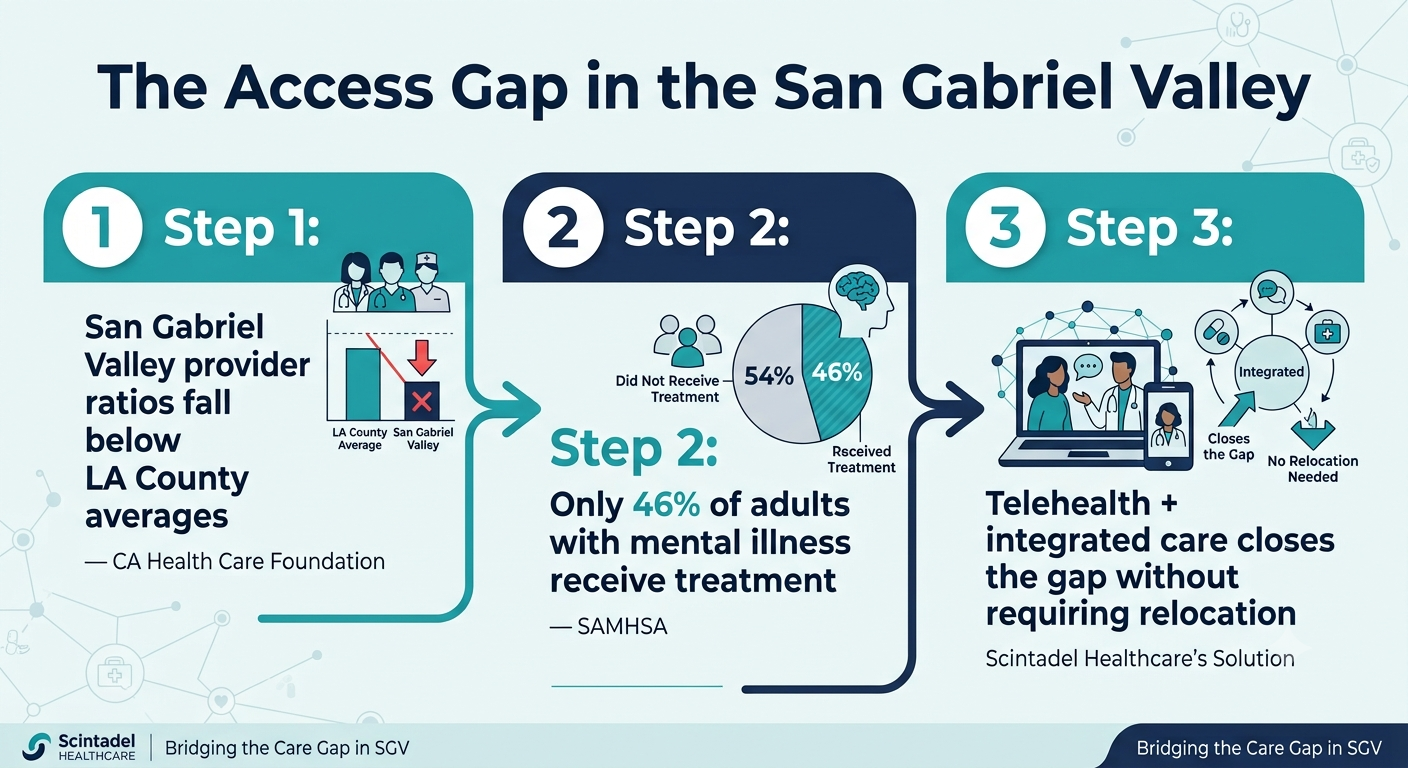
The consequences are real. According to SAMHSA, only 46% of adults with mental illness receive any treatment in a given year. In underserved communities, that figure drops further. Untreated psychiatric conditions don’t stay stable. They worsen and become harder to treat over time.
Telehealth has changed part of this picture. Initial evaluations and medication management can now happen virtually. Clinical outcomes for most presentations are comparable to in-person care. West Covina residents no longer need a Los Angeles commute to access quality psychiatric support.
What Does a Quality Psychiatric Evaluation Involve?
A psychiatrist in West Covina should conduct an initial evaluation lasting 60 to 90 minutes. Anything shorter cuts corners on essential clinical information. The evaluation covers your current symptoms across all life areas. It examines your psychiatric and medical history. It looks at your family history of mental health conditions. It reviews your substance use. It goes through prior treatment and what worked or didn’t.
That information is not optional background. It’s the clinical foundation for every decision that follows.
| What Gets Covered | Why It Matters |
| Current symptoms across life domains | Separates clinical conditions from situational stress |
| Prior psychiatric treatment and response | Avoids repeating failed approaches |
| Medical history and medications | Identifies physical contributors and drug interactions |
| Family mental health history | Informs diagnosis for mood and anxiety disorders |
| Substance use history | Affects diagnosis accuracy and medication safety |
A 20-minute intake ending in a prescription is not adequate care. It produces inaccurate diagnoses. It leads to treatment built on incomplete information.
How Does Integrated Care Improve Outcomes?
Psychiatric care delivered within an integrated model produces better outcomes than psychiatry in isolation. The reason is coordination. A psychiatrist who shares records with a primary care physician makes safer medication decisions. A primary care physician who talks to the psychiatric team catches medication side effects early. Neither operates with a partial clinical picture.
At Scintadel Healthcare, Inc., this coordination is structural. The general psychiatry services page explains how our clinical model works in practice. The Scintadel Healthcare home page covers the full range of integrated services.
| Care Dimension | Scintadel Integrated Model | Standalone Psychiatry Practice |
| Primary care coordination | Built-in, shared team | External referral, limited contact |
| Medication and therapy alignment | Coordinated within one ecosystem | Often siloed |
| Holistic services | Yoga, meditation, nutrition available | Typically unavailable |
| Telehealth | Available across all service lines | Varies widely |
| Continuity of care | Same clinical team every visit | Provider rotation common |
What Do Mental Health Facilities in Los Angeles Offer That Standalone Practices Don’t?
A comprehensive mental health facility in Los Angeles runs multiple service lines around a single patient. It coordinates warm handoffs between psychiatry, therapy, and primary care. Cold referrals that don’t convert are far less common. Complex co-occurring conditions get treated within the same system rather than across separate, unconnected providers.
For West Covina patients, this means access to that clinical depth without relocating. Scintadel Healthcare, Inc. extends its integrated model to patients across Southern California. Telehealth makes that access consistent and practical.
Scintadel Healthcare, Inc. Is Closing the Psychiatric Gap for West Covina Residents
Zip code should not determine the quality of your psychiatric care. At Scintadel Healthcare, Inc., we deliver board-certified psychiatric evaluation and integrated mental health support to communities across Southern California. West Covina residents deserve that standard of care. We’re committed to making it accessible.
FAQs
- Does Scintadel Healthcare offer psychiatric services for West Covina residents?
Yes. Through telehealth and our broader Southern California network, Scintadel provides board-certified psychiatric evaluation and medication management for West Covina patients.
- What insurance plans does Scintadel accept?
Sintadel accepts Cigna, United Healthcare, and BlueCross BlueShield, among others. Contact the team to verify your specific coverage before your first appointment.
- How is Scintadel’s psychiatric evaluation different from a GP visit?
A Scintadel psychiatrist conducts a 60-to-90-minute comprehensive evaluation. A general practitioner typically provides brief screening without the diagnostic depth complex conditions require.
- Can West Covina patients access care through telehealth?
Yes. Telehealth is available for evaluations, medication management, and follow-up appointments. Quality care is accessible without a Los Angeles commute. - Does Scintadel coordinate psychiatric care with therapy and primary care?
Yes. Scintadel’s integrated model connects psychiatry, primary care, counseling, and holistic services within one clinical ecosystem.