

PTSD Treatment in Los Angeles: Are You Getting Evidence-Based Care?
Most people living with PTSD don’t fit the stereotype. They’re not visibly distressed. They function. They show up to work, manage their relationships, and get through the day. But underneath that, something is always running in the background. Hypervigilance. Emotional numbness. Sleep that never quite restores. Triggers that arrive without warning. PTSD treatment in Los Angeles at a clinical level is designed for exactly this kind of presentation, not just the dramatic ones.
What Does PTSD Really Look Like?
PTSD is not limited to combat veterans. It develops after any event involving death, serious injury, or sexual violence. That includes interpersonal violence, childhood abuse, accidents, medical trauma, and refugee experiences. All of these are present in the Los Angeles population.
The DSM-5 identifies four symptom clusters. These are intrusion, avoidance, negative cognition and mood, and arousal and reactivity. Patients don’t present all four at equal intensity. The balance between clusters shapes which treatment approach fits best.
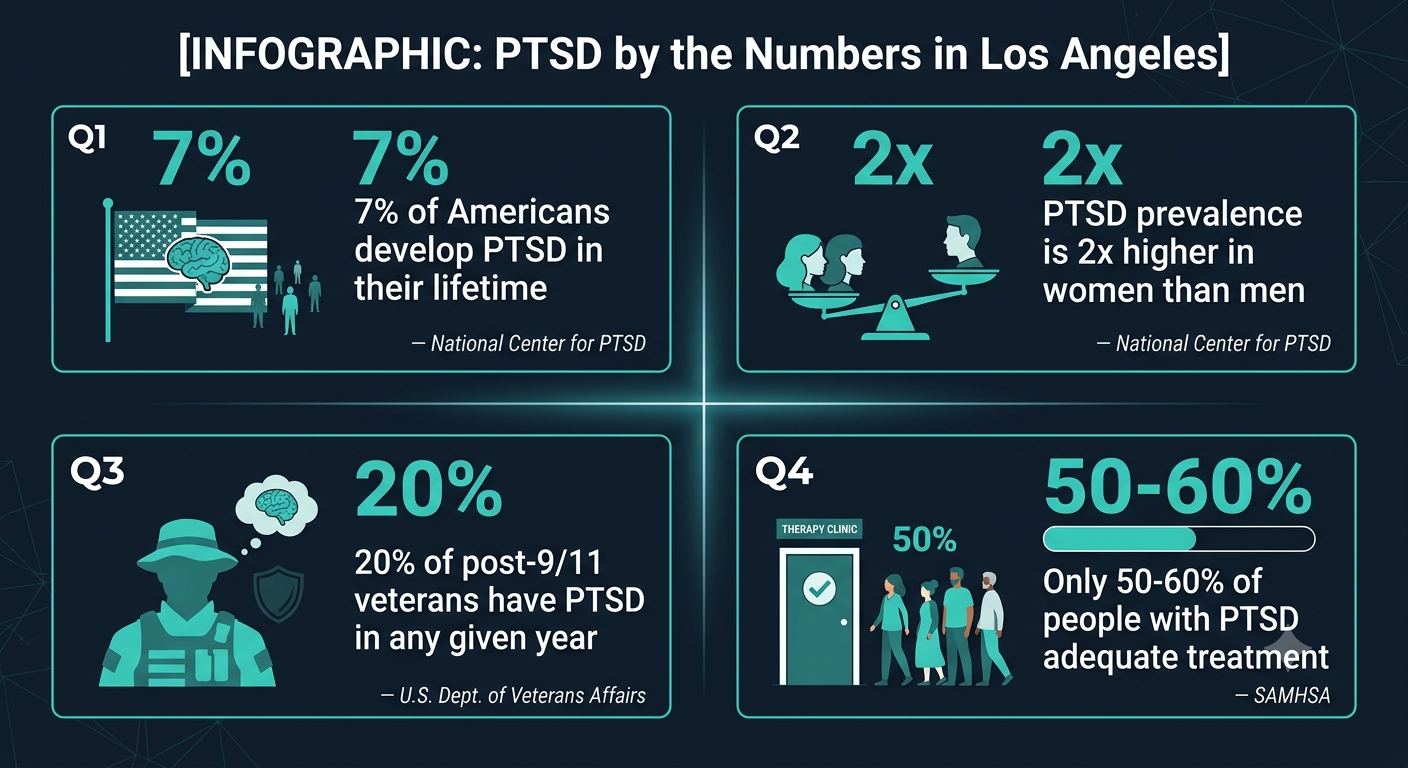
According to the National Center for PTSD, around 7% of Americans develop PTSD in their lifetime. Women develop PTSD at roughly double the rate of men. In Los Angeles County, those percentages represent hundreds of thousands of people.
Which Treatments Have the Strongest Evidence?
Two therapy protocols lead the evidence base. The VA/DoD Clinical Practice Guideline places both as first-line treatments.
Prolonged Exposure (PE) uses graduated, systematic confrontation of trauma memories and avoided situations. Repeated contact with feared stimuli, without the expected catastrophic outcome, teaches the nervous system the threat has passed. It produces significant symptom reduction across diverse trauma populations.
Cognitive Processing Therapy (CPT) targets the distorted beliefs trauma creates. Patients work through structured exercises to identify and challenge “stuck points.” These are the beliefs that block adaptive processing of what happened.
EMDR applies bilateral stimulation during brief, focused trauma recall. It reduces the emotional charge of traumatic memories. Multiple guidelines, including those from the WHO and APA, recognize it as effective for PTSD.
| Treatment | Evidence Level | Best For | Typical Duration |
|---|---|---|---|
| Prolonged Exposure (PE) | Strong RCT; first-line | Avoidance-dominated PTSD | 8–15 sessions |
| Cognitive Processing Therapy (CPT) | Strong RCT; first-line | Guilt, shame, cognitive distortions | 12 sessions |
| EMDR | Multiple guideline endorsement | Single-incident and complex trauma | 6–12+ sessions |
| Trauma-Sensitive Yoga | Growing evidence base | Somatic and dissociative presentations | Adjunctive |
| SSRI medication (sertraline, paroxetine) | FDA-approved for PTSD | Adjunctive to therapy | Ongoing |
How Does a PTSD Therapist Work Alongside a Psychiatrist?
A PTSD therapist in Los Angeles delivers the structured therapeutic work. A psychiatrist manages the neurobiological dimension. Medication can reduce symptom intensity enough to make exposure-based therapy feasible. Without that reduction, symptom severity sometimes blocks engagement with the therapeutic process entirely.
The coordination between the two roles determines outcomes. A therapist pushing exposure work without knowing a patient’s medication recently changed is working with incomplete information. A psychiatrist adjusting a dose without knowing the patient is mid-exposure hierarchy faces the same problem.
At Scintadel Healthcare, Inc., that coordination is built into the clinical model. The PTSD therapy page explains how the treatment approach is structured. The Scintadel Healthcare home page covers the broader integrated care model.
The previously published Scintadel blog on PTSD treatment in Los Angeles addresses the therapist selection question in further detail.
What Should a Quality PTSD Assessment Include?
A thorough PTSD assessment is not a symptom inventory. It covers the traumatic event history in clinical detail. It examines current symptoms across all four DSM-5 clusters. It assesses functional impairment across work, relationships, and daily life. It reviews prior treatment history and what produced results.
Co-occurring conditions are critical to screen for. Depression occurs alongside PTSD in more than half of cases. Substance use disorders are common and often represent untreated trauma coping. ADHD can complicate both the presentation and the treatment plan. An assessment that misses these conditions leads to a treatment plan built on an incomplete picture.
Reach out through the contact page to begin the assessment process. The Wikipedia entry on cognitive processing therapy provides useful background on one of the core treatment approaches.
Scintadel Healthcare, Inc. Delivers PTSD Treatment Built on Evidence
PTSD responds to the right treatment. The evidence on what that looks like is clear. What stands between too many Los Angeles patients and those outcomes is access to a practice that takes diagnosis seriously and coordinates psychiatric and therapeutic care within one framework. That is what Scintadel Healthcare, Inc. provides.
FAQs
- What is the most effective PTSD treatment currently available?
Prolonged Exposure and Cognitive Processing Therapy have the strongest evidence and are first-line recommendations per VA/DoD and APA clinical guidelines. - Does Scintadel provide PTSD-specific therapy rather than general trauma counseling?
Yes. Scintadel uses evidence-based PTSD protocols rather than generalized supportive counseling approaches. - How does medication fit into PTSD treatment at Scintadel?
Sertraline and paroxetine are FDA-approved for PTSD. Medication reduces symptom severity to make engagement with trauma-focused therapy more feasible when indicated. - Can Scintadel treat complex PTSD from prolonged childhood trauma?
Yes. Complex PTSD presentations, including dissociation and emotional dysregulation from childhood trauma, are within the clinical scope Scintadel’s team assesses and treats. - Is telehealth appropriate for PTSD therapy at Scintadel?
Yes. Research published in the Journal of Traumatic Stress shows telehealth delivery of PE and CPT produces outcomes comparable to in-person care for most presentations.