

Rancho Cucamonga Therapist: Find Care That Fits Your Life
Key Takeaways
- San Bernardino County is federally designated as a mental health professional shortage area, making the search for a qualified therapist in Rancho Cucamonga genuinely difficult.
- Therapeutic modality matters. Cognitive behavioral therapy, DBT, EMDR, and somatic approaches each work best for different presentations. Matching the method to the condition is essential.
- A standalone therapy practice operates with limited visibility into a patient’s broader health picture. An integrated model closes that gap.
- Patients who need both therapy and psychiatric medication management are extremely common and are often underserved by disconnected care systems.
- Telehealth therapy has significantly expanded access for Rancho Cucamonga and Inland Empire residents without requiring a Los Angeles commute.
- The right therapist is one whose training, approach, and availability fit your specific condition and actual life, not just your general preferences.
At Scintadel Healthcare, Inc., we know that finding a Rancho Cucamonga therapist is not simply a practical exercise in searching directories and checking insurance panels. It is a decision that involves trust, clinical fit, scheduling reality, and the kind of vulnerability that comes with seeking mental health support. We have built our practice around making that process easier and the care itself more effective once you are in it.
The Inland Empire is home to a growing population that has consistently faced a relative shortage of mental health providers. According to the Health Resources and Services Administration, San Bernardino County is designated as a mental health professional shortage area, meaning the ratio of mental health providers to residents falls below federally established adequacy thresholds. For Rancho Cucamonga residents specifically, that shortage makes the search for a qualified therapist more difficult and wait times longer than they should be.
What Should You Look for in a Therapist in Rancho Cucamonga?
The most important thing to look for is clinical fit for your specific presentation. A therapist excellent at treating relationship issues and life transitions may not be the best choice for someone managing OCD, trauma, or a severe mood disorder. Those conditions require specific training in evidence-based protocols, and a generalist approach will typically underperform compared to a specialist one.
Use this checklist when evaluating a therapist in Rancho Cucamonga:
| Evaluation Criteria | What to Ask or Verify |
|---|---|
| Licensure | Verified with the California Board of Behavioral Sciences |
| Condition-specific experience | Ask directly: “Have you treated [your condition] before?” |
| Therapeutic approach | Can they name their modality and explain why it fits your needs? |
| Scheduling availability | Does their availability actually match your schedule? |
| Insurance | Are they in-network, or do they offer a sliding scale? |
| Telehealth option | Is virtual care available if in-person becomes difficult? |
| Communication policy | How do they handle contact between sessions? |
Licensing credentials in California include Licensed Professional Clinical Counselors, Licensed Marriage and Family Therapists, Licensed Clinical Social Workers, and Psychologists. The credential category matters less than whether the therapist has specific training and supervised experience with what you are dealing with.
How to Choose the Right Therapist in Rancho Cucamonga
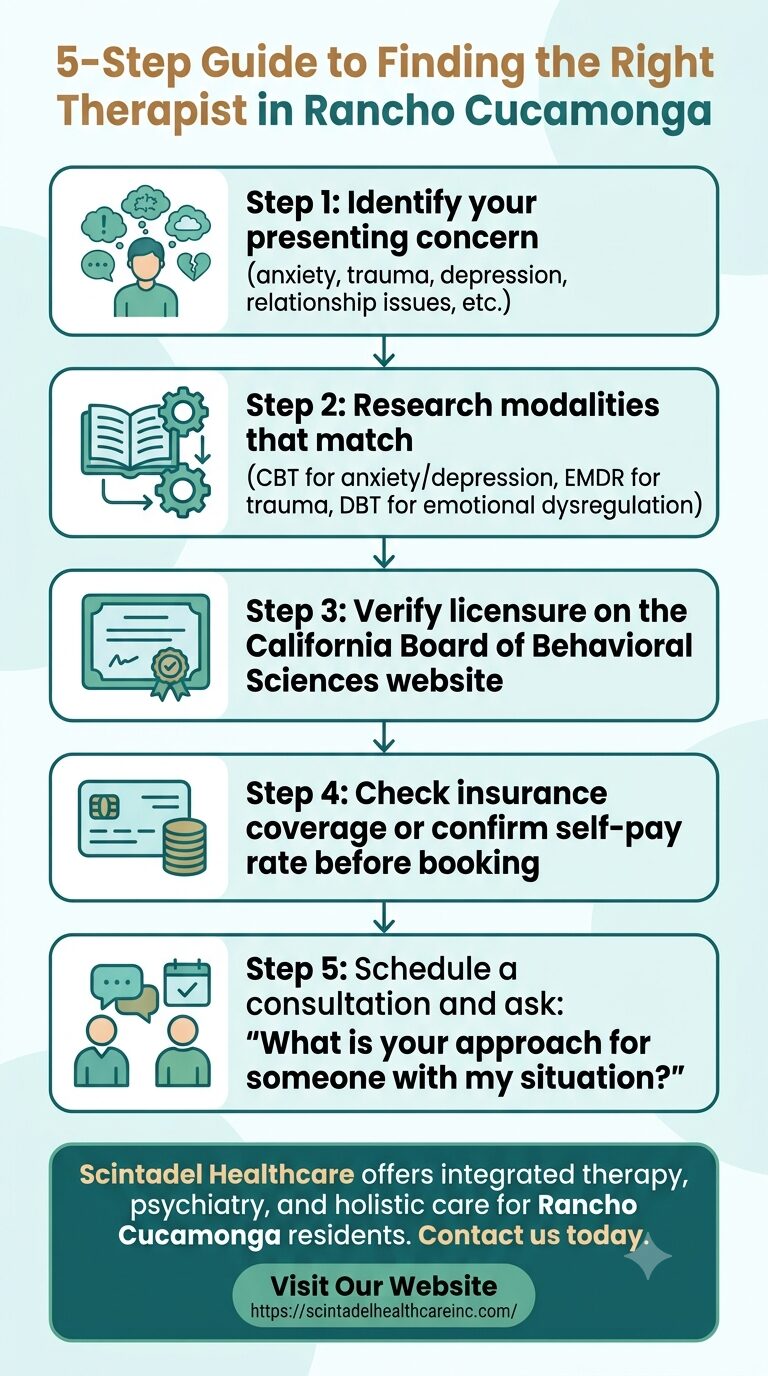
How Do Different Therapy Modalities Fit Different Presentations?
Choosing the right therapy modality for a condition is not arbitrary. The research on psychotherapy outcomes consistently shows that matching the modality to the presentation matters significantly for results.
| Therapy Modality | Best Suited For | What Happens in Session | Typical Duration |
|---|---|---|---|
| Cognitive Behavioral Therapy (CBT) | Depression, anxiety, OCD, phobias | Identifying and restructuring unhelpful thought patterns and behaviors | 8–16 sessions |
| Dialectical Behavior Therapy (DBT) | Emotional dysregulation, borderline features, self-harm | Skills training: distress tolerance, emotional regulation, mindfulness | 6 months to 1 year |
| EMDR | PTSD, single-incident trauma, complex trauma | Brief memory focus paired with bilateral stimulation (eye movements or tapping) | 6–12 sessions for single-incident; longer for complex |
| Prolonged Exposure (PE) | PTSD, trauma avoidance | Gradual, systematic confrontation of trauma memories and avoided situations | 8–15 sessions |
| Somatic Therapy | Trauma stored in the body, chronic pain, dissociation | Body-awareness techniques to release stored physiological stress | Varies; often paired with EMDR or CBT |
| Internal Family Systems (IFS) | Complex or childhood trauma, self-blame | Exploring different internal “parts” with curiosity and compassion | Varies by individual need |
The clinical team at Scintadel Healthcare, Inc. can help patients identify which therapeutic approach is most likely to be effective for their specific presentation through our general psychiatry services. Coordinated referral to appropriately specialized therapists is available when the indicated treatment falls outside our direct service scope.
What Makes Scintadel Healthcare, Inc. Different From a Standalone Therapy Practice?
A standalone therapy practice, however excellent, operates with limited visibility into the patient’s broader health picture. If a therapist notices signs of worsening depression but has no connection to a prescribing clinician, the pathway to medication evaluation involves a separate referral, a separate intake, and a period of disconnected communication between two providers who may never speak to each other. At Scintadel Healthcare, Inc., that fragmentation simply doesn’t exist.
| Feature | Scintadel Integrated Model | Standalone Therapy Practice |
|---|---|---|
| Therapy + psychiatry coordination | Same clinical team, shared records | External referral, separate systems |
| Primary care involvement | Available, built-in | External referral only |
| Medication management visibility | Therapist aware of medication status | Typically unknown unless patient shares |
| Holistic services (yoga, nutrition) | Integrated into care plan | Not available |
| Telehealth across all service lines | Yes | Varies by practice |
| Crisis pathway | Internal escalation to psychiatry | External referral or ER |
The Scintadel Healthcare homepage provides a full overview of the integrated care model. For patients wanting context on how therapy connects to the broader continuum of care, the Scintadel blog on counseling in Pasadena and Rancho Cucamonga addresses the distinctions and overlaps in detail.
How Does Scintadel Serve Patients Who Need Both Therapy and Psychiatric Care?
Patients who need both therapy and psychiatric medication management are extremely common in clinical practice, and they are often underserved by systems that require them to manage those two care relationships independently. At Scintadel Healthcare, Inc., therapy and psychiatry are coordinated within the same clinical framework. Treatment decisions in one area are made with awareness of what is happening in the other.
For Rancho Cucamonga residents, that coordination is particularly valuable given the Inland Empire’s mental health provider shortage. Finding both a therapist and a psychiatrist who communicate effectively, accept the same insurance, and have compatible clinical approaches is a significant logistical challenge when navigating the system independently. Scintadel’s integrated model reduces that friction considerably, and telehealth makes consistent access possible for patients whose schedules or transportation options make in-person visits difficult.
Contact the team through the contact page to get started. For more on what research says about the effectiveness of combined medication and therapy approaches, the Wikipedia entry on psychotherapy provides relevant clinical context.
Why Scintadel Healthcare, Inc. Is the Smart Choice for Rancho Cucamonga Residents Seeking a Therapist
Finding the right therapist in Rancho Cucamonga should not be harder than the work you do once you are in the sessions. Scintadel Healthcare, Inc. brings clinical quality, integrated care, and genuine accessibility to Inland Empire residents, making the search shorter and the results more lasting.
Frequently Asked Questions
- Does Scintadel Healthcare, Inc. offer both therapy and psychiatric medication management in Rancho Cucamonga?
Yes. Scintadel provides integrated care combining therapy coordination, psychiatric evaluation, and medication management for patients in the Rancho Cucamonga area.
- How do I know which type of therapist is right for my condition?
The clinical team at Scintadel can help guide that decision during an initial consultation, matching your presenting condition and preferences to the most appropriate therapeutic modality and provider type.
- What is the difference between a therapist and a psychiatrist at Scintadel Healthcare?
A therapist provides talk-based intervention without prescribing authority. A psychiatrist is a medical doctor who evaluates, diagnoses, and manages psychiatric conditions including prescribing when appropriate. Both are available through Scintadel.
- Can I access therapy at Scintadel Healthcare through telehealth if I’m in Rancho Cucamonga?
Yes. Telehealth therapy sessions are available, allowing Rancho Cucamonga residents to access care consistently without travel time as a barrier.
- Does Scintadel Healthcare accept insurance for therapy services?
Yes. Therapy services are covered by major commercial insurers under mental health parity laws. Contact the Scintadel team to verify your specific plan’s coverage before scheduling.