

Finding a Primary Care Physician in Los Angeles
Finding a primary care physician in Los Angeles should not feel like a part time job, but for a lot of residents, it does. Between long waitlists and physicians who are not accepting new patients, the process has become genuinely harder over the past few years. This guide walks through why that is happening, what a good primary care relationship should actually look like, and how to find a primary care physician in Los Angeles, CA that will still know your name five years from now.
Why has finding a primary care doctor gotten so much harder?
This is not just a feeling. California is short an estimated 3,490 primary care physicians as of 2025, according to projections from the National Center for Health Workforce Analysis, and the state’s physicians remain unevenly distributed relative to where people actually live (Healthforce Center at UCSF, 2025). That shortage sits on top of rising demand from a population that is aging quickly and increasingly managing multiple chronic conditions at once.
A separate driver deserves attention too. A 2025 study published in Annals of Internal Medicine, led by researchers at UCSF, Yale, and UCLA, tracked over 712,000 physicians and found clinical attrition jumped from 3.5 percent in 2013 to 4.9 percent in 2019, a 40 percent increase tied largely to administrative burden and staffing strain. Doctors are not just hard to find. Some of them are leaving clinical practice altogether.
How bad is the shortage really, in numbers?
Roughly six million Californians currently live in a designated Primary Care Health Professional Shortage Area, where less than half of the region’s primary care needs are being met, according to a Kaiser Family Foundation analysis of federal HRSA data. In the Inland Empire specifically, the ratio of primary care physicians drops as low as 35 per 100,000 residents, well below the federal benchmark of 60 to 80 per 100,000.
Nationally, the picture is not much better. The Association of American Medical Colleges projects the primary care shortfall could grow to as many as 40,400 clinicians by 2036, and roughly three in ten Americans already report difficulty accessing primary care today (USC Keck School of Medicine, 2026).
What should a good primary care relationship actually provide?
A strong primary care relationship is about more than annual checkups. It should include real continuity, meaning the same provider tracks your history over years rather than starting fresh every visit, and it should include coordination, meaning your primary doctor actually communicates with any specialists you see rather than working in isolation.
Access matters just as much as quality. A practice offering same-day or next-day availability, along with telehealth for straightforward follow-ups, closes a lot of the gap created by the statewide shortage without sacrificing the depth of care you actually need.
How does primary care connect to mental health and specialty care?
This is where an integrated model earns its value. When your primary care physician and your psychiatric provider are part of the same practice, medication interactions get caught faster, chronic conditions get managed with the full picture in mind, and you are not repeating your entire history to a new provider every time a new symptom shows up.
Telehealth plays a bigger role in that coordination than most patients assume. It cannot replace an annual physical or hands-on exam, but it works well for medication refills, lab result reviews, and straightforward follow-ups that do not require an in-person visit. For patients managing a chronic condition who would otherwise need to take half a day off work just to renew a prescription, that flexibility genuinely changes how consistently they stay engaged with their own care.
That kind of consistency compounds over time. A patient who stays engaged with the same coordinated team for years tends to catch problems earlier, simply because their provider has a real baseline to compare against, rather than reconstructing their history from scratch at every new appointment.
California Primary Care Access at a Glance
| Metric | Figure | Source |
|---|---|---|
| Statewide primary care physician shortage (2025) | 3,490 physicians | Healthforce Center at UCSF |
| Californians in a Primary Care Shortage Area | 6 million residents | Kaiser Family Foundation / HRSA |
| Inland Empire primary care ratio | 35 per 100,000 residents | Kaiser Family Foundation analysis |
| Federal benchmark ratio | 60 to 80 per 100,000 residents | HRSA |
| Americans reporting access difficulty | 3 in 10 adults | USC Keck School of Medicine, 2026 |
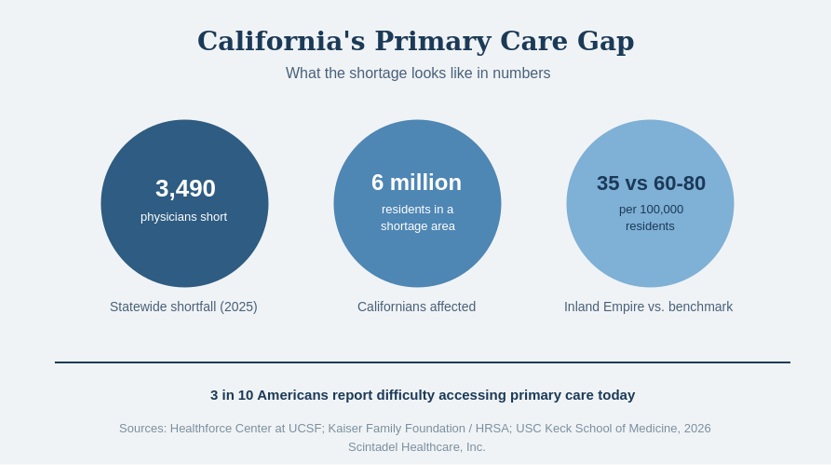
Infographic showing California primary care physician shortage statistics
A doctor who actually knows your file is worth the search
The shortage is real, and it is not resolving itself anytime soon. But that makes finding the right primary care relationship more important, not less. A provider who knows your history, coordinates with your other care, and stays reachable when something comes up is worth more than the nearest available appointment.
Primary Care Services are built around exactly that kind of continuity, integrated with mental health and specialty care under one roof for patients across Los Angeles. For a change, contact our team to get started, or visit our home page to see our full range of services.
Frequently Asked Questions
- Why is it so hard to find a primary care doctor accepting new patients in Los Angeles?
California faces an estimated shortage of thousands of primary care physicians, driven by rising demand, an aging population, and physicians leaving clinical practice due to administrative burden, which together strain availability across the region.
- How often should I actually see my primary care physician?
Most healthy adults benefit from at least one annual visit, though anyone managing a chronic condition or taking regular medication typically needs more frequent check-ins, often quarterly or as advised by their provider.
- Can my primary care physician coordinate with a psychiatrist?
Yes, and this kind of coordination genuinely improves care. When both providers are part of the same practice or actively communicate, medication interactions and overlapping symptoms get caught much faster.
- Is telehealth a reliable option for primary care visits?
For many routine visits, prescription refills, and follow-ups, yes. It has become a standard part of primary care and is particularly useful for patients balancing work schedules or living farther from a clinic.
- What should I bring to a first appointment with a new primary care physician?
A list of current medications, any recent lab results or medical records you have access to, and a clear sense of your main health concerns will help your provider build an accurate picture from day one.