
Meditation in Orange County and Pasadena: A Real Guide
Somewhere between the 91-freeway traffic and a phone that will not stop buzzing, a lot of us lost the ability to just sit still. That is exactly why interest in meditation in Orange County and meditation has grown so much over the past decade, not as a trend, but as a genuine response to how overstimulated daily life has become. This guide breaks down what the research actually shows, what a real practice looks like, and how it fits alongside clinical mental health care rather than replacing it.
What does the research actually say about meditation and stress?
The evidence here is not thin. A 2022 study found that participants who practiced mindfulness saw a significant reduction in perceived stress and anxiety, along with improved markers of inflammation in the body (National Center for Complementary and Integrative Health, NCCIH). Separate research on focused attention meditation found measurable reductions in blood pressure and cortisol, the hormone most directly tied to chronic stress.
None of this means meditation in Pasadena replaces medical care. It means it is one of the few low-risk, evidence-backed tools that genuinely moves the needle on how your body responds to stress, which is exactly why it fits so naturally alongside psychiatric and primary care.
Can meditation really help with anxiety the way medication does?
This is where the research gets genuinely surprising. A 2023 randomized controlled trial involving 208 participants with anxiety disorders found that mindfulness-based stress reduction performed just as well as escitalopram, a commonly prescribed anxiety medication, over the course of the study (NCCIH; JAMA Psychiatry, 2023). That does not mean meditation should replace medication for everyone. It means for the right patient, under the right guidance, it can be a legitimate part of a treatment plan rather than a nice-to-have extra.
A separate 2021 trial involving adults with generalized social anxiety disorder found that mindfulness-based stress reduction produced long-term benefits comparable to structured cognitive behavioral group therapy. The takeaway is consistent across the research: meditation is not a soft alternative to real treatment. It is real treatment, when it is applied with intention.
How many people in the U.S. are actually meditating regularly?
More than you might think, and the number keeps climbing. Meditation use among U.S. adults jumped more than threefold between 2012 and 2017, from 4.1 percent to 14.2 percent, according to the CDC’s National Center for Health Statistics. That growth has continued as awareness of the clinical research has spread beyond wellness circles and into mainstream healthcare conversations.
What does a realistic meditation practice look like for a beginner?
Forget the idea that you need to sit cross-legged for an hour to get anything out of this. Most of the research showing measurable benefit involved structured programs lasting eight weeks, with sessions closer to twenty or thirty minutes a handful of times per week, not marathon sessions. Consistency matters far more than duration.
A realistic starting point looks like short, guided sessions focused on breath and body awareness, gradually building toward longer unguided practice as it becomes more natural. Pairing meditation with movement, like the breathing-focused approach used in many yoga practices, often makes the habit easier to sustain long term.
The most common obstacle is not lack of interest, it is the expectation that meditation should feel calm and easy from the very first session. In reality, sitting with your own thoughts without distraction can feel uncomfortable at first, especially for anyone dealing with high stress or an overactive schedule. Naming that discomfort ahead of time, rather than treating it as a sign you are doing it wrong, makes people far more likely to stick with a practice long enough to see the benefits the research actually points to.
Meditation and Mindfulness Use Among U.S. Adults
| Year | Adults Practicing Meditation | Source |
|---|---|---|
| 2012 | 4.1 percent | CDC / NCHS National Health Interview Survey |
| 2017 | 14.2 percent | CDC / NCHS National Health Interview Survey |
| 2022 (as part of yoga practice) | 54.9 percent of yoga practitioners | CDC / NCHS Data Brief No. 501 |
| 2023 anxiety trial outcome | Comparable to escitalopram | JAMA Psychiatry, 2023 |
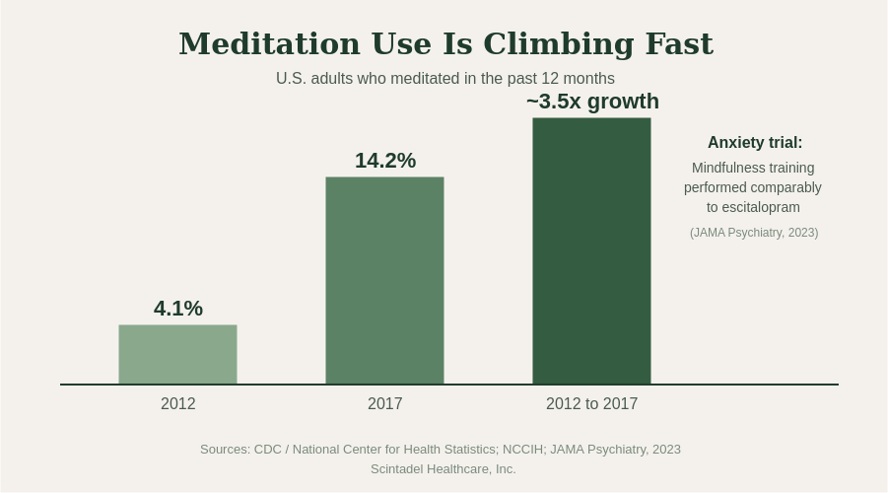
Infographic showing growth of meditation use among U.S. adults from 2012 to 2017 and clinical trial outcomes.
Building a calmer nervous system, one honest session at a time
Meditation is not about achieving a blank mind or becoming a different person. It is a trainable skill that, according to a growing body of clinical research, measurably changes how your body handles stress, anxiety, and even physical pain. Whether you are just starting out or looking to pair a practice with existing mental health care, the science supports treating it as a genuine tool rather than a wellness accessory.
Scintadel Healthcare integrates meditation and holistic care alongside psychiatric and primary care services, so your practice supports the rest of your treatment instead of existing in isolation. Explore our Yoga Classes and Holistic Care or General Psychiatry Services to see how a coordinated approach might fit your life, and visit our home page for the full picture of what we offer across Orange County and Pasadena
Frequently Asked Questions
- How long does it take to see benefits from meditation?
Most clinical studies showing measurable benefit used structured programs lasting around eight weeks, with regular short sessions rather than occasional long ones. Some people notice a calmer baseline within a few weeks, though results vary by individual.
- Can meditation replace anxiety medication entirely?
For some people, under professional guidance, it can be a comparable option, as shown in controlled trials against escitalopram. That decision should always be made with a psychiatric provider who knows your full history, not on your own.
- Do I need a quiet dedicated space to meditate effectively?
It helps, but it is not required. Consistency matters more than the perfect environment. Many people build a sustainable habit with a simple ten to fifteen minute guided session anywhere they can sit undisturbed.
- Is meditation safe for people with severe anxiety or trauma?
Generally yes, and it is considered low risk for most healthy adults, though people with significant trauma histories sometimes benefit from starting under professional guidance rather than an unsupervised app or video.
- How does meditation fit alongside primary care and psychiatry?
It works best as a complement, not a substitute. A coordinated care team can help you understand where meditation fits alongside medication, therapy, or lifestyle changes, rather than leaving you to figure it out alone.