
Yoga in Los Angeles and Orange County: What Helps
Yoga in Los Angeles stopped being a niche activity a long time ago, and the national data backs that up. But between studios promising everything from weight loss to spiritual awakening, it is worth separating what yoga in Los Angeles and Orange County studios actually deliver, backed by research, from what is mostly marketing. This guide breaks down the real numbers and how a grounded practice can genuinely support your health.
How many people are actually practicing yoga right now?
Yoga has moved firmly into the mainstream. In 2022, 16.9 percent of U.S. adults practiced yoga in the past twelve months, according to the CDC’s National Center for Health Statistics, up substantially from 9.5 percent a decade earlier. That is not a niche wellness trend anymore. That is close to one in six adults nationwide.
What does yoga actually do for pain and stress, according to research?
The 2022 CDC data brief found that 80 percent of adult yoga practitioners cited restoring overall health as their reason for practicing, while 28.8 percent specifically used yoga to treat or manage physical pain. Separate NCCIH-backed research found mindfulness-based stress reduction, often incorporated into yoga practice, associated with short-term improvement in chronic low-back pain, and a 2017 clinical practice guideline from the American Cancer Society specifically recommends yoga for anxiety and stress reduction during and after cancer treatment.
Yoga in Orange County, CA is not a cure-all, and no honest studio or clinician will tell you it is. But the evidence for its role in managing stress, mild to moderate pain, and general nervous system regulation is genuinely solid, not just anecdotal.
Not every style delivers the same effect either, and picking the wrong one for your goals is a common early mistake. Slower, restorative styles built around sustained poses and controlled breathing tend to align more closely with the research on stress and cortisol reduction, while faster-paced flow classes lean more toward physical conditioning. Neither is wrong, but knowing the difference helps you choose a class that actually matches why you are showing up in the first place, rather than picking whatever studio happens to be closest.
Who is practicing yoga, and why does that matter?
Participation skews notably by demographics, and understanding that helps explain access gaps. Women practice yoga at more than twice the rate of men, 23.3 percent versus 10.3 percent, and participation is highest among adults ages 18 to 44 at 21.3 percent, dropping to 8 percent among adults 65 and older (CDC/NCHS, 2024). Participation also rises with household income, from 10.4 percent among lower-income adults to 23 percent among the highest income bracket, which points to real cost and access barriers that studios in Los Angeles and Orange County can help close through community classes and sliding-scale options.
How should someone new to yoga actually get started?
Skip the idea that you need flexibility before you start. Among practitioners, 89.9 percent incorporate breathing exercises and 51.2 percent attend structured classes rather than practicing alone, which suggests guided instruction is genuinely how most people build a sustainable habit (2012 National Health Interview Survey data). A slower, breath-focused style is usually a better entry point than an intense flow class, especially for anyone managing stress, anxiety, or physical pain rather than training for athletic performance.
It also is not a direct substitute for cardiovascular training, and most instructors will say so honestly. What yoga offers instead is a combination most traditional workouts do not, meaning strength, flexibility, and a structured breathing practice built into the same session. For people who find gym environments intimidating or physically uncomfortable, that combination often becomes the more sustainable entry point into regular movement, which matters more long term than any single workout’s calorie burn.
The best studios in Los Angeles and Orange County tend to make this distinction clear upfront, offering both gentler restorative classes and more athletic flow sessions rather than a single one-size-fits-all format. Asking a studio how they structure their beginner offerings is a fair question, and a good one will have a specific answer rather than a vague reassurance.
Yoga Participation Among U.S. Adults by Group
| Group | Past-Year Yoga Participation | Source |
|---|---|---|
| All U.S. adults (2022) | 16.9 percent | CDC / NCHS Data Brief No. 501 |
| Women | 23.3 percent | CDC / NCHS, 2024 |
| Men | 10.3 percent | CDC / NCHS, 2024 |
| Adults ages 18 to 44 | 21.3 percent | CDC / NCHS, 2024 |
| Adults age 65 and older | 8.0 percent | CDC / NCHS, 2024 |
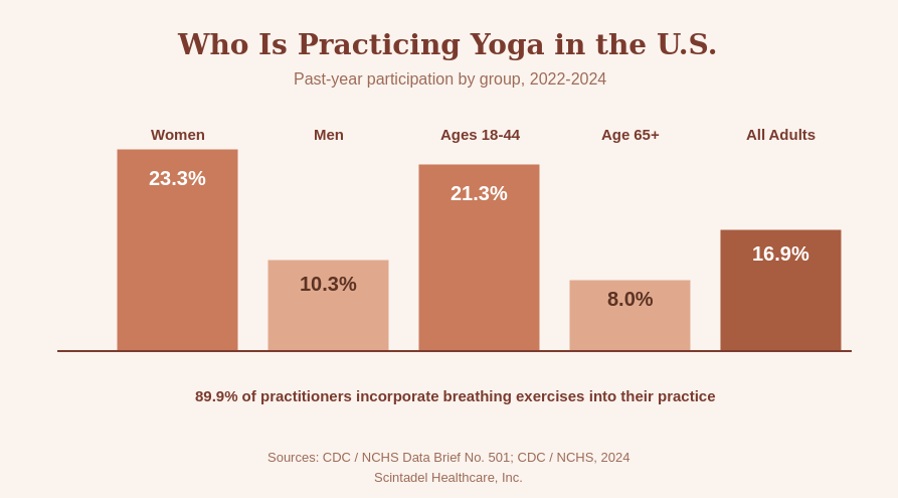
Infographic showing yoga participation statistics among U.S. adults by demographic group
A practice worth taking seriously, not just trying once
Yoga’s reputation as a soft, optional wellness activity does not really hold up against the data. It is a low-risk, evidence-supported practice for managing stress, mild pain, and nervous system regulation, and it works best as part of a broader approach to health rather than a standalone fix.
Scintadel Healthcare’s Yoga Classes and Holistic Care integrate movement and breathwork alongside our medical and mental health services, so your practice supports the rest of your care plan. Explore our full offerings for Los Angeles and Orange County residents, contact our team with questions, or visit our home page to learn more.
Frequently Asked Questions
- Do I need to be flexible to start practicing yoga?
No. Flexibility develops with consistent practice, it is not a prerequisite. Most beginner classes are designed specifically for people with no prior experience or limited mobility.
- How often do I need to practice yoga to see real benefits?
Research supporting yoga’s benefits for stress and pain generally involved regular practice, often multiple sessions per week over several weeks, rather than occasional classes. Consistency matters more than intensity.
- Can yoga help with anxiety or chronic stress specifically?
Yes, this is one of the more well-supported benefits in the research, particularly when yoga incorporates breathing exercises and mindfulness, which the majority of practitioners already include in their practice.
- Is yoga safe for older adults?
Generally yes, though research notes a higher rate of yoga-related injuries treated in emergency departments among adults 65 and older, so choosing a gentler style and an instructor experienced with older adults matters.
- Should yoga replace medical treatment for a health condition?
No. Yoga works best as a complement to medical care, not a replacement, particularly for anyone managing a diagnosed physical or mental health condition alongside their practice.